Generative Design in 2026: State of the Field
Generative design has decisively moved beyond its roots in classical topology optimization — it now encompasses AI-driven, multi-constraint, and diffusion-model-based approaches that are reshaping engineering workflows across aerospace, automotive, construction, and additive manufacturing. As of March 2026, the field is experiencing a convergence of simulation intelligence, manufacturability-aware AI, and agentic design systems.
Topology Optimization Redefined
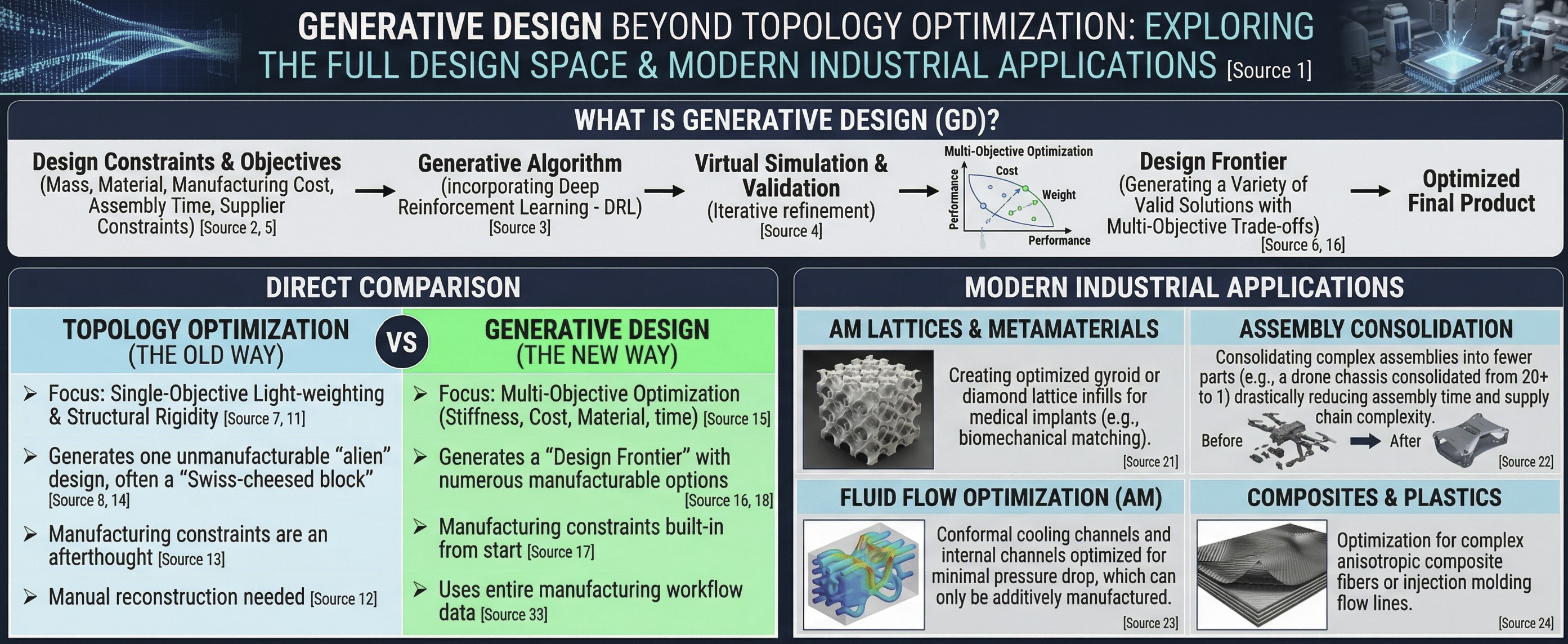
The traditional view of generative design as synonymous with topology optimization is being actively challenged. Topology optimization returns a single optimal design based on physics constraints, whereas true generative design is fundamentally about design space exploration — producing multiple candidate geometries simultaneously. Tools like Autodesk Fusion 360 Generative Design, Altair Inspire, and nTopology now go significantly further, incorporating manufacturing method constraints (CNC, die casting, additive manufacturing) directly into the generation loop.
A major algorithmic breakthrough came from a Brown University–Lawrence Livermore–Simula Research Laboratory collaboration, whose new SiMPL algorithm reduces the number of topology optimization iterations by up to 80%, potentially shrinking compute time from days to hours and enabling finer-resolution designs at industrial scale.
Diffusion Models: The New AI Frontier
The most transformative recent research is the integration of generative diffusion models with topology optimization. MIT's TopoDiff architecture (now extended into 2026 research) uses conditional diffusion models to generate performance-aware and manufacturability-aware topologies, outperforming traditional GAN-based approaches. A new MIT GenAI Lab project, led by Prof. Faez Ahmed and Prof. Josephine Carstensen, is building a manufacturability-aware diffusion transformer framework that integrates structural performance metrics and graph-based fabrication constraints directly into the model's conditioning — bridging the simulation-to-real gap.
A parallel paper published in Engineering Applications of Artificial Intelligence (2026) proposes a diffusion-to-GAN hybrid model specifically for structural topology optimization, blending the generative diversity of diffusion models with the discriminative sharpness of GANs. Additionally, a new ScienceDirect study on metamaterial generative design combines the Denoising Diffusion Probabilistic Model (DDPM) with Persistent Homology (PH) techniques to achieve topology-aware generation with precise structural control.
From Design Exploration to Synthetic Data Factories
A conceptually significant 2026 development reframes generative design as a "Synthetic Data Factory" — rather than relying on scarce real-world AEC drawings, GD algorithms mass-produce tens of thousands of logically consistent design input–output pairs to train domain-specific AI models. This paradigm shift from passive data collection to active data production is particularly relevant for BIM workflows, where a Deterministic Geometry Reconstruction (DGR) post-processing algorithm ensures engineering precision after probabilistic AI inference.
Generative AI for Aerospace & Structural Engineering
A March 2026 paper published in Case Studies in Construction Materials (ScienceDirect) explores generative design combined with topology optimization for single-layer aluminum alloy grid shell connections, demonstrating real-world structural applicability in civil/architectural engineering contexts. Separately, a 2026 ScienceDirect study introduces a generative AI–driven topology optimization framework for aerospace drone components, using density-based methods to achieve significant mass reductions in flight-critical structures.
These results align with the broader industrial trend: generative design now delivers 30–50% faster time-to-market, 10–50% weight reductions, and up to 20% cost savings in production engineering contexts.
The Integrated AI Design Workflow
The emerging industry consensus, articulated clearly in a March 2026 CoLab analysis, describes a three-stage AI pipeline that is now the logical roadmap for hardware engineering:
- Upstream: Generative design tools produce constraint-satisfying candidate geometries.
- Midstream: AI design review tools validate candidates for manufacturability, tolerancing, and standards compliance.
- Downstream: Manufacturing AI translates validated designs into production plans.
This pipeline does not yet exist at industrial scale, but its components are maturing in parallel — and their integration is the defining challenge of generative design in 2026.
Key Upcoming Events & Platforms
- The CDFAM Computational Design Symposium — Barcelona 2026 (announced March 18, 2026) is showcasing a new high-performance topology optimization solver specifically designed to bridge computational efficiency with massive simulation-driven design exploration.
- The WCCM 2026 Mini-Symposium (Munich, July 2026) will address Agentic AI and Physics-Informed Machine Learning for design optimization — signaling that autonomous, multi-physics generative systems are the next research frontier.
- The field is at an inflection point: classical topology optimization is being absorbed into a far broader generative AI ecosystem that is physics-aware, fabrication-constrained, and increasingly agentic — with 2026 marking the transition from specialized research tools to integrated industrial design systems.
About the Author
Nay Linn Aung is a Senior Automation & Robotics Engineer (M.S. Computer Science — Data Science & AI) specializing in the convergence of OT and IT.