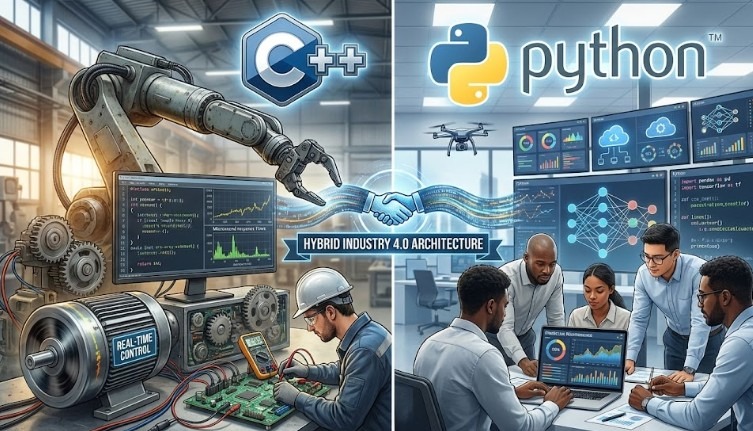
The industrial automation landscape in 2026 is defined by a clear division of labor: C++ governs the hard-real-time, low-level control layer, while Python has aggressively expanded into high-level automation logic, AI-driven process control, SCADA systems, IIoT integration, and rapid prototyping. Neither language has "won" — instead, they co-exist in a layered architecture that has become the dominant engineering pattern across smart factories, robotics, and Industry 4.0 deployments.
The Core Technical Divide
C++ remains the language of choice for performance-critical, deterministic automation tasks. As a compiled language, it translates directly to machine code, enabling the microsecond-level response times demanded by hard real-time control loops — such as servo motor torque commands at 2000 Hz, robot joint controllers, and low-level PLC ladder logic execution. Its direct memory access, pointer control, and compatibility with RT-Linux and RTOS kernels make it irreplaceable in industrial arms, drones, and autonomous vehicles.
Python, by contrast, operates as an interpreted language, which introduces overhead unsuitable for safety-critical hard real-time loops. However, Python compensates through 2–10× faster development speeds compared to C++, enabling automation engineers to script HMI logic, data pipelines, SCADA dashboards, and AI inference layers in a fraction of the time.
Python's Industrial Automation Surge in 2026
Python's footprint in the industrial space has expanded dramatically, largely driven by three forces:
- OPC-UA / IIoT integration: Python is now a primary language for building OPC-UA clients and servers, connecting PLCs, RTUs, and SCADA systems via secure machine-to-machine protocols. Projects like Python-based virtual PLC/RTU simulators using IEC 62541 OPC-UA-TCP are actively used for training, testing, and fault-injection in industrial environments.
- AI/ML at the Edge: Python's TensorFlow, PyTorch, and Scikit-learn ecosystems make it the backbone of predictive maintenance, quality inspection vision systems, and anomaly detection in manufacturing lines. Anaconda AI Navigator in 2026 supports LLaMA v3.1 and GPT v4.2 with built-in quantization tools — directly applicable to edge inference on factory floors.
- SCADA & HMI Development: Python-backed SCADA frameworks (supporting OPC-UA, Modbus-TCP, and Serial communications) with React frontends are being actively deployed. Siemens WinCC SCADA integration with Python and OPC-UA is now a documented production pattern. The FrameworX platform added Python MCP (Model Context Protocol) support, bringing AI agent capability directly into SCADA supervisory control.
The Robotics Programming Stack in 2026
As of March 2026, the robotics and industrial automation programming stack has stabilized into a well-defined dual-language architecture:
C++ handles performance-critical tasks while Python manages rapid prototyping and high-level control — and the integration between these two layers is considered the most architecturally significant challenge in modern robotics engineering.
Strengths & Dominance
Python's Key Advantages for Industrial Engineers:
- Rapid prototyping: Python enables teams to build and test automation logic over weekends, not sprints
- IIoT connectivity: Libraries like
python-opcua,pyModbus, andpyserialoffer out-of-the-box industrial protocol support - MicroPython / CircuitPython: Python now runs directly on microcontrollers for IoT and embedded deployments
- AI integration: Python is the control plane for AI-driven automation, with no rival ecosystem
- SCADA scripting: Python increasingly replaces proprietary scripting languages in SCADA platforms, improving maintainability
C++'s Enduring Advantages in Industrial Automation:
- Hard real-time guarantees: Lock-free data structures, RT-Linux kernel compatibility, and nanosecond determinism
- Embedded systems dominance: Smart sensors, PLCs, industrial PCs, and embedded controllers still run C++ firmware
- Memory control: Manual memory management enables zero-allocation control loops critical to safety-critical systems
- Qt framework: C++ with Qt is the industry standard for industrial HMI panel design, demonstrated at Embedded World 2026
- Mature toolchain: GDB, Valgrind, and compile-time optimization give C++ an edge for debugging memory-intensive automation software
The Hybrid Architecture: Industry's Consensus Answer
The prevailing professional consensus as of March 2026 is not "Python or C++" — it is Python and C++, with each language occupying its optimal tier. Python holds a commanding 29.6% language market share with +1.7% year-over-year growth, making it the top language by adoption, while C++ endures as a "high-performance heavyweight" indispensable for embedded and real-time systems.
Published just today (March 23, 2026), Tech-Act notes that Python's role in AI, cloud computing, and automation has expanded significantly while its simplicity still enables organizations to standardize workflows across multiple engineering teams using a single language. Meanwhile, Rust is beginning to challenge C++ in the systems programming space for new greenfield industrial projects, particularly where memory safety is critical — though C++ retains dominant incumbency in existing automation infrastructure.
Practical Recommendation for Industrial Automation Engineers
- Use C++ for: PLC firmware, hard real-time motion control, safety-rated interlocks, embedded drivers, and low-latency sensor loops.
- Use Python for: OPC-UA/Modbus SCADA integration, AI-based predictive maintenance, IIoT data pipelines, HMI scripting, digital twin modeling, rapid prototyping, and factory analytics dashboards.
About the Author
Nay Linn Aung is a Senior Automation & Robotics Engineer (M.S. Computer Science — Data Science & AI) specializing in the convergence of OT and IT.